• Episode 39 - "It Wasn't Always So" with Professor Yair Halevy
    Sep 15 2026

    It Wasn’t Always So In this episode, I speak with Yair Halevy, a researcher of Haredi (ultra-Orthodox) history, thought and sociology, about one of the most fascinating and surprising shifts in modern Jewish history: the transformation from what he calls “old Haredism” to “new Haredism.” Today, many people assume that the Haredi relationship to the State of Israel, Zionism, the army and broader Israeli society has always looked more or less the way it does now. Yair’s research challenges that assumption. We discuss his work on the mainstream Haredi response to the Six Day War, including the remarkable enthusiasm that appeared in Haredi newspapers and among major rabbinic voices at the time. In some cases, the victory was described in deeply religious and even redemptive language, including references to Geula (redemption) and the possibility that history was moving in a dramatically new direction. From there, we explore what changed in the following years. Yair describes three major features of “old Haredism”: a more positive posture toward the State of Israel, greater power in the hands of Haredi politicians and journalists, and a broader social and cultural openness to general Israeli society. By the 1970s, much of that began to shift. The conversation touches on the Six Day War, the rise of a more separatist Haredi identity, the movement of public authority toward rabbinic leadership, the brother-and-sister affair involving Rav Goren, the relationship between Haredim (ultra-Orthodox Jews) and religious Zionists, and the ways communities reshape their own memory over time. This is a conversation about Haredi society, Israeli history, Zionism, Geula (redemption), authority, openness, separation and the question of whether the present was really as inevitable as it often appears. Learn more about Yair Halevy’s doctoral dissertation, “The ‘New Haredism’ Revolution in Israel in the 1970’s,” here: https://cris.biu.ac.il/en/studentTheses/the-new-haredism-revolution-in-israel-in-the-1970s/

    Show More Show Less
    1 hr and 5 mins
  • Episode 38- Between Torah and Derech Eretz
    Aug 24 2026

    In this episode, I speak with Rabbi Rafael Dembovsky about his new book, Between Torah and Derech Eretz: A Hashkafic and Halachic Analysis of the Torah im Derech Eretz and Torah Only Viewpoints. The conversation explores one of the most enduring and consequential debates in Orthodox Jewish life: What is the proper relationship between Torah and the broader world? For some, the ideal religious life means engaging the world and using its opportunities, disciplines and responsibilities in the service of G-d. For others, the ideal is withdrawal from the outside world in pursuit of spiritual purity, personal perfection and full immersion in Torah. These are often treated as sociological camps or communal identities, but Rabbi Dembovsky argues that the question is much deeper. It is a serious Torah debate, rooted in Chazal (the Sages), Rishonim (early rabbinic authorities) and Acharonim (later rabbinic authorities), with major implications for how we think about education, work, secular studies, bitachon (trust in G-d), hishtadlus (human effort), and the shape of a Torah society. We discuss why this topic cannot be reduced to slogans, why each side has deep sources and serious claims, and how a clearer understanding of the dispute can lead not only to sharper thinking, but also to greater respect across different parts of Klal Yisrael (the Jewish people). This is a conversation about Torah im Derech Eretz (Torah with worldly involvement), Torah Only, work, learning, modernity, hashkafa (Jewish thought), halacha (Jewish law), and the challenge of pursuing truth without flattening complex Torah debates into simple communal labels. Order the book from Mosaica Press here: https://mosaicapress.com/product/between-torah-and-derech-eretz/

    For more quality content, join our weekly newsletter: https://iyun.org.il/en/join-our-newsletterOur Facebook Page: https://www.facebook.com/Tzarichiyun

    Show More Show Less
    1 hr and 3 mins
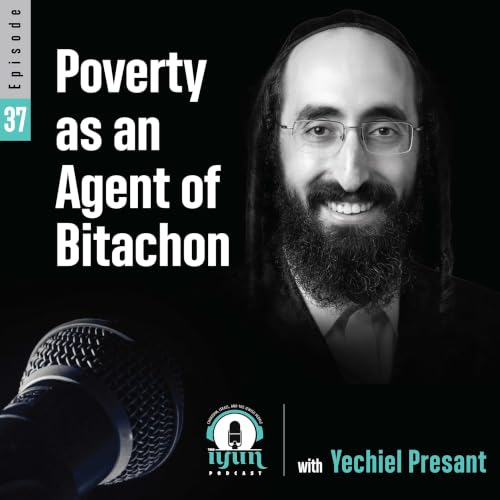
  • Episode 37 - Poverty as an Agent of Bitachon with Yechiel Presant
    Aug 9 2026

    In this episode, we speak with Yechiel Presant about his provocative essay, “Vessels of Blessing: Poverty, Faith, and Human Agency in Charedi Society.” Conversations about Charedi poverty often focus on familiar questions: secular education, professional training, workforce participation, government support and the economic cost of a society centered around Torah learning. Presant does not dismiss those issues, but he argues that they miss something deeper: a religious psychology that can sometimes weaken human agency. At the heart of the conversation is a subtle but powerful question: what happens when emunah and bitachon are misunderstood in a way that makes people passive? If prosperity is seen mainly as a sign that one “deserves” blessing, and poverty is seen as a Divine verdict, then practical effort can begin to feel irrelevant. Instead of asking, “What vessel do I need to build?” a person may wait for blessing to arrive without developing the skills, habits, confidence and discipline needed to receive it. A Breslover chassid, Presant’s argument is not a rejection of Torah values or a call to replace emunah with materialism. It is the opposite. He argues that real emunah should restore dignity, responsibility and initiative. Hashem sends blessing, but human beings must prepare the vessels. This is a conversation about poverty, but it is also about much more than poverty: responsibility, learned helplessness, religious language, human dignity, bitachon and the kind of inner strength Torah is meant to produce. Read the article here: https://iyun.org.il/en/sedersheni/vessels-of-blessing/

    Show More Show Less
    45 mins
  • Episode 36 - "Waiting for Moshiach...or Bringing him?"
    Jul 5 2026

    What does it really mean to anticipate redemption? In this episode, I speak with Pinchas Freudiger about his provocative critique of contemporary Charedi thinking: that our understanding of Mashiach and Geula has become too passive and too deeply shaped by an exilic mindset.

    We discuss why Torah must address not only the spiritual lives of individuals and communities, but also the great questions of national life: justice, governance, human dignity and the creation of a model society that can serve as a light unto the nations. Pinchas argues that genuine emunah means believing in the good life the Torah promises, and developing the courage, imagination and practical readiness to begin building toward it.

    Read Pinchas’s essay, “Did You Anticipate Redemption?”

    For more quality content, join our weekly newsletter: https://iyun.org.il/en/join-our-newsletterOur Facebook Page: https://www.facebook.com/Tzarichiyun

    Show More Show Less
    1 hr and 2 mins
  • Episode 35 - Is Violence the Answer? with R' Yehoshua Pfeffer
    Jun 17 2026

    In this episode, we take a hard look at a growing crisis within the Torah world: what happens when a system built around the ideal of total Torah immersion leaves too many young men without genuine learning, productive work, responsibility, or purpose? Drawing on Rabbi Yehoshua Pfeffer’s provocative essay, we explore how idleness can lead not only to boredom, but to anger, extremism, and the erosion of the dignity and character traditionally associated with a ben Torah. The conversation challenges us to distinguish between protecting the Torah world and defending a system that may no longer be serving everyone within it, and asks what honest leadership, meaningful expectations, and constructive alternatives might look like.

    Read the article here: “Idleness, Anger, and the Erosion of the Torah World”. (iyun.org.il)

    For more quality content, join our weekly newsletter: https://iyun.org.il/en/join-our-newsletterOur Facebook Page: https://www.facebook.com/Tzarichiyun

    Show More Show Less
    44 mins
  • Episode 34 - Poverty and Identity in the Chareidi Community
    May 27 2026

    Dr. Nechumie Yaffe is a Haredi scholar and lecturer at Tel Aviv University whose work focuses on Haredi sociology and the challenge of translating the lived experience of the ultra-Orthodox world to audiences outside of it. Her research explores the tensions, assumptions, and internal complexities of Haredi society, offering a rare voice from within the community who can both analyze it academically and articulate it authentically.

    In this episode, we discuss the sociology of the Haredi world, how insiders and outsiders often misunderstand one another, and what is gained when the Haredi experience is explained with nuance rather than caricature.

    For more quality content, join our weekly newsletter: https://iyun.org.il/en/join-our-newsletter Our Facebook Page: https://www.facebook.com/Tzarichiyun

    Show More Show Less
    59 mins
  • Episode 33 - Chareidi Women in Tech...in the IDF?!
    May 10 2026

    Esti Salomon is the founder and CEO of Atida, a pioneering Israeli nonprofit creating new pathways for ultra-Orthodox women to serve in elite technological units within the IDF as civilian employees. Under her leadership, Atida has placed more than 400 women in prestigious roles in units such as Unit 8200, the Air Force’s Ofek Unit, the Communications Corps, and the Ground Forces Command. In addition to her groundbreaking leadership, Esti is currently pursuing her Ph.D. at Bar-Ilan University, where her doctoral research focuses on the emerging phenomenon of ultra-Orthodox women working within the IDF. In this episode, we discuss the intersection of Haredi society, military service, women’s professional advancement, and Israeli social change, and what Atida’s work reveals about the evolving future of the ultra-Orthodox community in Israel.

    For more quality content, join our weekly newsletter: https://iyun.org.il/en/join-our-newsletter Our Facebook Page: https://www.facebook.com/Tzarichiyun

    Show More Show Less
    49 mins
  • Episode 32 - Tradition or Innovation: Gender Roles in Chareidi Society
    Apr 26 2026

    Mrs. Miriam Kosman is originally from Baltimore, Maryland, a longtime resident of Bnei Brak, and now lives in Afula in Israel’s north. The daughter, descendant, and wife of distinguished talmidei chachamim, she has emerged as one of Orthodoxy’s most compelling thinkers on the subject of Judaism and gender. Her groundbreaking work, Circle, Arrow, Spiral, draws on academic insight, psychological depth, and the esoteric teachings of Judaism, particularly those of Rav Moshe Shapiro zt”l, to offer a rich and often countercultural framework for understanding masculine and feminine spiritual energies in Torah thought. In our conversation, we explore the theological dimensions of gender in Judaism, along with contemporary expressions, common misconceptions, and some of the stranger distortions that have emerged in the current cultural moment.

    For more quality content, join our weekly newsletter: https://iyun.org.il/en/join-our-newsletter Our Facebook Page: https://www.facebook.com/Tzarichiyun

    Show More Show Less
    1 hr and 3 mins