Episodes

  • Dry Falls and the Blue Lake Rhino
    Dec 1 2025

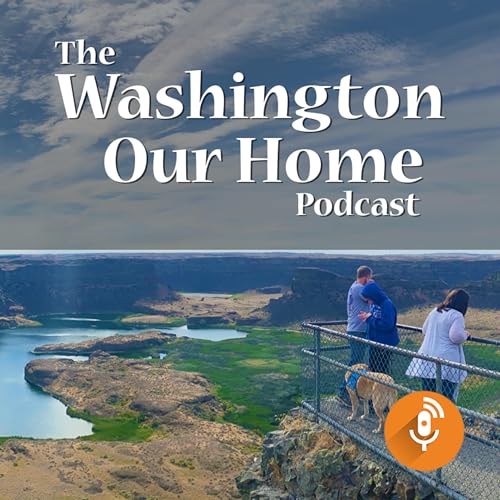
    In central Washington, between Grand Coulee Dam and Moses Lake is a place called Dry Falls, one of the most visually beautiful and geologically unique places in the world. It gets its name, not from being one of the hotter, drier climates in Washington - though as any visitor in mid-July would argue it certainly is - No…it's called Dry Falls because where once flowed ten times the combined amount of water of all the rivers in the world…today, there is nothing. In fact, during its peak in the last Ice Age, the massive waterfall was five times the width and three times the height of the famous Niagara Falls. I'm Erich Ebel, your fearless field guide to Washington State history, heritage and culture, and today we'll take a trip to Dry Falls. It's one of my favorite places to visit in all of Washington, and we're going to explore its fascinating history - including a narrative tour through the storied Blue Rhino cave. All that, plus some fast facts and trivia coming up on this episode of Washington Our Home.

    Show More Show Less
    40 mins
  • Mount Rainier
    Nov 3 2025

    Mount Rainier is easily one of the most iconic symbols representing Washington state to the world…even though only two fifths of the state is actually considered mountainous. But as its snow-capped peak rises boldly above the western and central parts of Washington—its serene silhouette belies a history shaped by violent geological forces, mystical Native traditions, stalwart pioneering spirit, and valiant environmental efforts—all culminating in the creation and legacy of Mount Rainier National Park. I'm Erich Ebel, your fearless field guide to Washington state history, heritage and culture, and this is the story of Mount Rainier, right here in Washington, our home.

    Show More Show Less
    42 mins
  • The Pursuit of Harry Tracy
    Aug 4 2025

    Over the course of just a few months in 1902, Harry Tracy escaped one of the toughest prisons in the Pacific Northwest, gunned down guards and deputies, outsmarted posses, and vanished into forests and wheat fields as hundreds hunted him. To some, he was a monster. To others, he was a tragic figure — a man born too late, chasing a dying dream of freedom that could only end in blood. But legends often gloss over the grime behind the glory. Today we strip away the romanticized veneer and look plainly at a man whose path of violence left shattered lives, terrorized families, and a reputation built not on heroism but on cold-blooded calculation. A man driven by self-preservation at any cost. And in the end, his life was exactly what he’d promised it would be: short, violent, and uncompromising. I'm Erich Ebel, your fearless field guide to Washington state history, heritage and culture, and this is the pursuit of Harry Tracy in Washington Our Home.

    Show More Show Less
    35 mins
  • The Spokane Sun-God
    Aug 5 2024

    Battling violent storms, forest fire smoke, head winds and fatigue, a pair of Spokane, Washington, aviators flew nonstop across America and back in 1929 to establish a new world record. Their Buhl CA-6 sesquiplane, named Spokane Sun-God, was the first airplane to make a non-stop transcontinental round-trip flight. Sponsored by the National Air Derby Association along with Texaco, who supplied the gas, Buhl Aircraft Company, who provided the plane, and many Spokane citizens and businessmen, pilot Nick Mamer and mechanic Art Walker took to the skies at 6 p.m. and headed west into the sunset from Felts Field on August 15th as a crowd of thousands looked on.

    Show More Show Less
    49 mins
  • Exploring Maritime Washington
    Apr 3 2023

    I am proud to announce the publication of my new book, Exploring Maritime Washington—a History and Guide. Each of the places covered in its pages has a connection to Washington’s maritime history, whether a popular tourist destination or a hidden gem known only to longtime locals. Exploring Maritime Washington provides visitors with a fun and easy way to enjoy each community while learning about Washington’s nautical history. By visiting and experiencing Washington’s special maritime features—museums, ships, lighthouses, waterfronts and all—the heritage traveler can obtain an authentic understanding of maritime Washington’s diverse history and culture.

    Show More Show Less
    1 hr and 14 mins
  • Spokane’s Garbage Goat
    Mar 6 2023
    Installed in 1974, just in time for the World's Fair Exposition in Spokane, Washington, this iconic structure has delighted children and adults visiting the Inland Northwest for generations—but it isn't the canted pavilion that once marked the US presence at the fair, or the gondola across Spokane Falls that takes visitors so close they can feel the spray on their faces, or even the German beer garden facility that now houses the 1909 Looff Carrousel (which is on the National Register of Historic Places). No, those destinations in Riverfront Park are amazing remnants of a global event that drew 5,187,826 visitors, including US presidents, foreign dignitaries, and Hollywood stars. Those icons, still in use today, are enthralling…the one we're talking about, some might say, kind of sucks.Spokane's famous Garbage Goat has kept its corner of the park free of debris for nearly 50 years. I happen to have a long relationship with the burnished Bovidae. Growing up in Spokane, we often visited our voracious friend…taking pictures, goofing around, and searching for anything we could possibly find to satiate its never-ending hunger. And when we ran out of trash, nearby leaves and sticks would fall victim to the goat. And sometimes…once in a great while…Spokane's garbage goat would even suck the mitten right off some poor unsuspecting child's hand.To really tell the story right, we have to go back to the early 1960s, when Seattle held its Century 21 World's Fair exposition in 1962. I'll cover that story in a future podcast episode for sure, but for now let's just remember that the fair was a huge success, bringing nearly 10 million people, revitalizing Seattle's economic and cultural life, and leaving behind the Space Needle, the monorail, several sports venues and performing arts buildings, and—unlike some other world's fairs of its era—making a profit for the city. By comparison, little old Spokane wasn't sure it could duplicate the success of its westside counterpart. But hey…if you're going to dream, dream big!The theme of the 1974 World's Fair was Ecology, and every pavilion—from the USSR to the Japanese, the South Koreans to Canada, Australia, Iran, West Germany, and the Philippines—all of them were focused on some sort of environmental theme. And a more fitting location for an environmental fair would be hard to find, what with the natural beauty of the Spokane River cutting right through the middle of the festivities, and the falls creating a constant cacophony of environmental ambiance.On May 4, 1974, President Richard M. Nixon presided over the opening of Expo '74, the Spokane World's Fair. Spokane's population at that time was about 170,000, making it the smallest city ever to host a world's fair. When Nixon formally declared the Fair open, officials released 50,000 balloons into the sky (which is funny, given the Fair's environmental theme. Lord only knows where those ended up; they don't just vanish, after all).Portions of the speech made by President Richard Nixon at the Opening Ceremony. Footage courtesy of Dr. Larry Cebula, edited by Anna Harbine. Information from Cory Carpenter, “When Nixon Came to the Fair,” Spokane Historical, accessed March 5, 2023, https://spokanehistorical.org/items/show/384.To make room for the US Pavilion, the iconic structure that still looms large over Riverfront Park today, city officials had to tear down the historic 1902 Great Northern railroad depot on Havermale Island. The only remnant that remained from Spokane's earliest railroad days is the 155-foot-tall clock tower, which quickly became another beloved piece of Spokane's downtown skyline.In the years leading up to the '74 world's fair, most of the Spokane community was either dead set against it or totally committed to it. There were very few residents with ambivalent attitudes. One of the more committed members of the community was a Catholic named Sister Paula Mary Turnbull,
    Show More Show Less
    26 mins
  • Virginia V and the Mosquito Fleet
    Sep 5 2022

    Before there were roads around the Puget Sound region, there were rivers. Before the stagecoaches, there were Salish canoes. And before the planes, the trains, and the automobiles...there was the water, and the ships that traveled upon it. By the 1860s, there were hundreds of steamers crisscrossing the Puget Sound, every day, all day. There were, in fact, so many ships upon the water at any given time, that an article in the Tacoma Daily Ledger on February 21, 1889, implied that when viewed from a lofty point, the fleet looked like a swarm of mosquitos skimming over the green waters of the Sound. And the nickname stuck.

    Show More Show Less
    56 mins
  • Wilkeson’s Historic Coke Ovens
    Jul 4 2022
    Boasting a population of just under 500, the small community of Wilkeson, Washington, lies in the heart of Pierce County's Carbon River Valley. Once a lively and vibrant mining community, it has withstood the test of time…despite seeing an end to its primary economic driver. But rather than resign itself to a fate of joining the ranks of dozens of other ghost towns throughout the state, Wilkeson has endured. And its residents have turned what was once an industrial eyesore into a unique and fascinating historical attraction that helps bolster Wilkeson's blue-collar heritage. Join me as we blast, drill, and dig deep into the earth to discover the gritty, sweat-soaked story of Wilkeson. We'll remember the town's last living coal miner, and we'll see how residents today are turning their past into a promising future.
    Show More Show Less
    24 mins